


Wikipediadan təsadüfi məlumatlar :
 | |
 | |
 | |
| Names | |
|---|---|
| IUPAC name
Potassium cyanide
| |
| Identifiers | |
CAS Number
|
|
3D model (JSmol)
|
|
| ChEBI |
|
| ChemSpider |
|
| ECHA InfoCard | 100.005.267 |
| EC Number |
|
PubChem CID
|
|
| RTECS number |
|
| UNII |
|
| UN number | 1680 |
CompTox Dashboard (EPA)
|
|
InChI
| |
SMILES
| |
| Properties | |
Chemical formula
|
KCN |
| Molar mass | 65.116 g·mol−1 |
| Appearance | White crystalline solid deliquescent |
| Odor | faint, bitter almond-like |
| Density | 1.52 g/cm3 |
| Melting point | 634.5 °C (1,174.1 °F; 907.6 K) |
| Boiling point | 1,625 °C (2,957 °F; 1,898 K)[1] at 101.3 kPa |
Solubility in water
|
|
| Solubility in methanol | 4.91 g/100 ml (20 °C (68 °F; 293 K)) |
| Solubility in glycerol | soluble[quantify] |
| Solubility in formamide | 14.6 g/100 ml |
| Solubility in ethanol | 0.57 g/100 ml |
| Acidity (pKa) | 11.0 |
Magnetic susceptibility (χ)
|
37.0×10⁻⁶ cm3/mol |
Refractive index (nD)
|
1.410 |
| Thermochemistry | |
Std molar
entropy (S⦵298) |
127.8 J⋅K−1·mol-1 |
Std enthalpy of
formation (ΔfH⦵298) |
−131.5 kJ⋅mol−1 |
| Hazards | |
| GHS labelling:[1] | |
Pictograms
|
   
|
Signal word
|
Danger |
Hazard statements
|
H290, H300+H310+H330, H372, H410 |
Precautionary statements
|
P234, P260, P262, P264, P270, P271, P273, P280, P284, P301+P310+P330, P302+P350, P304+P340+P310, P307+P311, P314, P362, P390, P391, P403+P233, P405, P501 |
| NFPA 704 (fire diamond) | 
4
0
1 |
| Flash point | Non-flammable |
Threshold limit value (TLV)
|
5 mg/m3 (TWA), 5 mg/m3 (skin) (C) |
| Lethal dose or concentration (LD, LC): | |
LD50 (median dose)
|
|
| NIOSH (US health exposure limits):[3] | |
PEL (Permissible)
|
5 mg/m3 (TWA, skin) |
REL (Recommended)
|
5 mg/m3 (ceiling, 4.7 ppm, 10-minute) |
IDLH (Immediate danger)
|
25 mg/m3 |
| Safety data sheet (SDS) | ICSC 0671 |
| Related compounds | |
Other anions
|
|
Other cations
|
|
Related compounds
|
Acetonitrile |
Except where otherwise noted, data are given for materials in their standard state (at 25 °C [77 °F], 100 kPa).
 verify (what is verify (what is  ?) ?)
Infobox references
| |

Potassium cyanide is a compound with the formula KCN. It is a colorless salt, similar in appearance to sugar, that is highly soluble in water. Most KCN is used in gold mining, organic synthesis, and electroplating. Smaller applications include chemical gilding and buffing of jewelry.[4] Potassium cyanide is highly toxic, and a dose of 200 to 300 milligrams will kill nearly any human.
The moist solid emits small amounts of hydrogen cyanide due to hydrolysis (reaction with water). Hydrogen cyanide is often described as having an odor resembling that of bitter almonds.[5][6]
The taste of potassium cyanide has been described as acrid and bitter, with a burning sensation similar to lye.[7] However, potassium cyanide kills so rapidly its taste has not been reliably documented.[citation needed] In 2006, an Indian man killed himself using potassium cyanide. In the suicide note he left, the final words written were that potassium cyanide "burns the tongue and tastes acrid".[8][9]
Production
[edit]KCN is produced by treating hydrogen cyanide with an aqueous solution of potassium hydroxide, followed by evaporation of the solution in a vacuum:[4]
- HCN + KOH → KCN + H2O
About 50,000 short tons (45,000,000 kg) of potassium cyanide are produced yearly.[4]
Historical production
[edit]Before 1900 and the invention of the Castner process, potassium cyanide was the most important source of alkali metal cyanides.[4] In this historical process, potassium cyanide was produced by decomposing potassium ferrocyanide:[10]
- K4[Fe(CN)6] → 4 KCN + FeC2 + N2
Structure
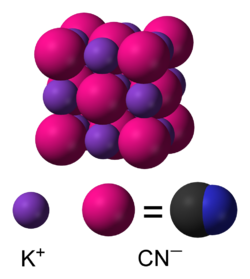
[edit]In aqueous solution, KCN is dissociated into hydrated potassium (K+) ions and cyanide (CN−) ions. As a solid, KCN has structure resembling sodium chloride: with each potassium ion surrounded by six cyanide ions, and vice versa. Despite being diatomic, and thus less symmetric than chloride, the cyanide ions rotate so rapidly that their time-averaged shape is spherical. At low temperature and high pressure, this free rotation is hindered, resulting in a less symmetric crystal structure with the cyanide ions arranged in sheets.[11][12]
Applications
[edit]KCN and sodium cyanide (NaCN) are widely used in organic synthesis for the preparation of nitriles and carboxylic acids, particularly in the von Richter reaction. It also finds use for the synthesis of hydantoins, which can be useful synthetic intermediates, when reacted with a carbonyl compound such as an aldehyde or ketone in the presence of ammonium carbonate.[citation needed]
KCN is used as a photographic fixer in the wet plate collodion process.[13] The KCN dissolves silver where it has not been made insoluble by the developer. This reveals and stabilizes the image, making it no longer sensitive to light. Modern wet plate photographers may prefer less toxic fixers, often opting for sodium thiosulfate, but KCN is still used.[needs update]
In the 19th century, cyanogen soap, a preparation containing potassium cyanide, was used by photographers to remove silver stains from their hands.[14]: 11 [15]: 73
Potassium gold cyanide
[edit]In gold mining, KCN forms the water-soluble salt potassium gold cyanide (or gold potassium cyanide) and potassium hydroxide from gold metal in the presence of oxygen (usually from the surrounding air) and water:
- 4 Au + 8 KCN + O2 + 2 H2O → 4 K[Au(CN)2] + 4 KOH
Analytical chemistry
[edit]In analytical chemistry, potassium cyanide is used as complexing agent for chemical analysis of zinc in water and wastewater. The cyanide group complexes zinc and other heavy metals, which is separated and analyzed in a spectro-photometer.[16]
Toxicity
[edit]Potassium cyanide is a potent inhibitor of cellular respiration, acting on mitochondrial cytochrome c oxidase, hence blocking oxidative phosphorylation. Lactic acidosis then occurs as a consequence of anaerobic metabolism. Initially, acute cyanide poisoning causes a red or ruddy complexion in the victim because the tissues are not able to use the oxygen in the blood. The effects of potassium cyanide and sodium cyanide are identical, and symptoms of poisoning typically occur within a few minutes of ingesting the substance: the person loses consciousness, and brain death eventually follows. During this period the victim may suffer convulsions. Death is caused by histotoxic hypoxia/cerebral hypoxia. The expected LD100 dose (human) for potassium cyanide is 200–300 mg while the median lethal dose LD50 is estimated at 140 mg.[17]
Disposal
[edit]Due to toxicity considerations, the disposal of cyanide is subject to stringent regulations. Industrial cyanide effluent is typically destroyed by oxidation using peroxysulfuric acid, hydrogen peroxide, sulfur dioxide/copper salts ("Inco process") or all three ("Combiox Process"). Use of sodium hypochlorite, traditional for laboratory-scale wastes, is impractical on a commercial scale. Hydrolysis at higher temperatures is highly effective, but requires specialized equipment. Lastly, cyanide wastes can be acidified for recovery of hydrogen cyanide.[4]
References
[edit]- ^ a b Sigma-Aldrich Co., Potassium cyanide.
- ^ "Cyanides (as CN)". Immediately Dangerous to Life or Health Concentrations. National Institute for Occupational Safety and Health.
- ^ "NIOSH Pocket Guide to Chemical Hazards".
- ^ a b c d e Gail, Ernst; Gos, Stephen; Kulzer, Rupprecht; Lorösch, Jürgen; Rubo, Andreas; Sauer, Manfred; Kellens, Raf; Reddy, Jay; Steier, Norbert; Hasenpusch, Wolfgang (2011). "Cyano Compounds, Inorganic". Ullmann's Encyclopedia of Industrial Chemistry. doi:10.1002/14356007.a08_159.pub3. ISBN 978-3-527-30385-4.
- ^ "Suicide note reveals taste of cyanide". The Sydney Morning Herald. 8 July 2006.
- ^ Not everyone, however, can smell cyanide; the ability to do so is a genetic trait.Online Mendelian Inheritance in Man (OMIM): 304300
- ^ "The only taste: Cyanide is acrid". hindustantimes.com. Hindustan Times. 8 July 2006.
- ^ Associated Press (9 July 2006). "Suicide note reveals taste of cyanide". The Sydney Morning Herald. No. World. Nine Entertainment Co. Retrieved 2 May 2025.
- ^ Labatut, Benjamín; West, Adrian Nathan (2020). "1". When We Cease to Understand the World. New York: New York Review Books. pp. 16–18. ISBN 9781681375663. Retrieved 2 May 2025.
- ^ Von Wagner, Rudolf (1897). Manual of chemical technology. New York: D. Appleton & Co. pp. 474 & 477.
- ^ Crystallography Open Database, Structure of KCN
- ^ H. T. Stokes; D. L. Decker; H. M. Nelson; J. D. Jorgensen (1993). "Structure of potassium cyanide at low temperature and high pressure determined by neutron diffraction". Physical Review B (Submitted manuscript). 47 (17): 11082–11092. Bibcode:1993PhRvB..4711082S. doi:10.1103/PhysRevB.47.11082. PMID 10005242..
- ^ Wood, Gaby (6 July 2010). "Collodion photography: self-portrait in cyanide". www.telegraph.co.uk. The Telegraph. The Telegraph. Retrieved 5 November 2025.
- ^ Crookes, William, ed. (10 September 1858). "Photographic Notes and Queries". The Photographic News: A Weekly Record of the Progress of Photography. 1 (1). London: Cassell, Petter, and Galpin: 10–12.
- ^ Browne, G. Lathom; Stewart, C. G. Reports of Trials for Murder by Poisoning; by Prussic Acid, Strychnia, Antimony, Arsenic, and Aconita. Including the trials of Tawell, W. Palmer, Dove, Madeline Smith, Dr. Pritchard, Smethurst, and Dr. Lamson, with chemical introduction and notes on the poisons used. London: Law Publishers and Booksellers..
- ^ Pawlowski, Lucjan (March 1994). "Standard methods for the examination of water and wastewater, 18th edition". Science of the Total Environment. 142 (3): 227–228. Bibcode:1994ScTEn.142..227P. doi:10.1016/0048-9697(94)90332-8. ISSN 0048-9697.
- ^ Trestrail III, John Harris (30 April 2007). Criminal Poisoning - Investigational Guide for Law Enforcement, Toxicologists, Forensic Scientists, and Attorneys (2nd ed, 2007 ed.). Humana. p. 119. ISBN 978-1588299215.
External links
[edit]Molecules detected in outer space | ||||||||||||||||||||
|---|---|---|---|---|---|---|---|---|---|---|---|---|---|---|---|---|---|---|---|---|
| Molecules |
| |||||||||||||||||||
| Deuterated molecules |
| |||||||||||||||||||
| Unconfirmed |
| |||||||||||||||||||
| Related |
| |||||||||||||||||||
| ||||||||||||||||||||


Authority control databases | |
|---|---|
| International |
|
| National |
|
| Other |
|
Kommunal ödənişləri qeydiyyatsız və sürətli həyata keçirin
Kommunal.az onlayn ödənişi asanlaşdırır. Onlayn Ödə, Ödəniş tarixçənizi yadda saxlayın, Hesablarınızı avtomatik ödəyin, Kartdan karta pul köçürün
Bakıda kommunal xidmətləri onlayn ödəmək 💳 ödəniş işıq pulu ödənişi ⚡️ mənzil və kommunal xidmətlər 💰 kirayə 🔒 təhlükəsiz ✅ Azərbaycanda istənilən bank kartından 📞 * 1919 | EPUL
“ASAN Kommunal” mərkəzləri bazar ertəsi - cümə günləri saat 09:00-dan-18:00-dək, şənbə günü isə saat 10:00-17:00-dək nahar fasiləsi olmadan fəaliyyət göstərir. “ASAN Kommunal” mərkəzlərində sənədlərin qəbulu həftənin beş günü saat 09:00-dan 17:30-dək, şənbə günü isə saat 10:00-dan 16:30-dək fasiləsiz həyata keçirilir.
Azərbaycan Respublikası Prezidentinin 06 avqust 2008-ci il tarixli 2983 saylı sərəncamını həyata keçirmək məqsədi ilə Bakı şəhər İcra Hakimiyyəti Başçısı 02 fevral 2009-cu il tarixdə 45 saylı sərəncamla, Bakı şəhərinin inzibati ərazisində əmələ gəlmə mənbəyindən asılı olmayaraq, bütün bərk məişət tullantılarının daşınması və zərərsizləşdirilməsini Bakı şəhər İcra Hakimiyyəti Aparatı Mənzil Kommunal Təsərrüfatı Departamentinin İxtisaslaşdırılmış Sanitariya – Təmizlik və Kommunal Xidmətlər İdarəsinə həvalə etmişdir.
Hesab.az offers online payments for Mobile, Utilities, TV, Internet, Phone and many other services
Bank Ödənişləri - Online Kommunal Ödənişlər. İndi siz mobil, internet, sığorta, bank və kredit ödənişlərinizi asanlıqla online odeme formada edə bilərsiniz. Onlayn Odeme Sizə daha yaxın
Onlayn xidmətlər - Kredit, kommunal ödənişlər, eləcə də arayış və çıxarışların alınması. Banka gəlmədən Kapital Bankın online odeme xidmətindən banka gəlmədən yararlanın
Mobile operators · Bank Services · Insurance · Phone · Kommunal Services · Cable TV · Internet · Other · Entertainment.
Elektron pul kisəsinə saytdan və ya mobil proqram vasitəsilə daxil olun. "Kommunal ödənişlər" bölməsini seçin. Öz ödəniş kodunuzu və məbləği daxil edin.
Hökumət ödənişləri Bank xidmәtlәri Mobil operatorlar Telefon Kommunal xidmәtlәr İnternet TV Sığorta Təhsil Taksi və Çatdırılma Otellər və Turizm Әylәncә
Hökumət Ödəniş Portalı (HÖP) – ölkə iqtisadiyyatında nağdsız hesablaşmaların genişləndirilməsi və bütün regionlarda maliyyə xidmətlərinə çıxış imkanlarının artırılması məqsədilə Azərbaycan Respublikası Mərkəzi Bankı tərəfindən yaradılmışdır. Portal vasitəsilə mərkəzləşdirilmiş qaydada vergi, rüsum, icarə haqqı və digər büdcə ödənişlərinin, həmçinin kommunal, rabitə və başqa kütləvi xidmətlər üzrə ödənişlərin internet üzərindən ödəniş kartlarından, bank hesablarından istifadə edilməklə, həmçinin bankların və milli poçt operatorunun maliyyə xidməti nöqtələrində nağd qaydada toplanılması təmin edilmişdir.
Çoxfunksiyalı “ASAN ödəniş” sistemi cərimə, kommunal xidmət, kabel televiziyası, mobil operator, internet və digər ödənişləri qısa zamanda, təhlükəsiz və rahat şəkildə həyata keçirmək imkanı yaradır. Respublika daxilində geniş ərazini əhatə edən “ASAN Ödəniş” terminalları, həmçinin www.asanpay.az portalı və “ASAN Pay” mobil əlavəsi vasitəsilə istənilən xidmət üzrə heç bir məhdudiyyəti olmadan 24/7 ödəniş etmək mümkündür.
Bütün xidmətlər bir Ödəmə Nöqtəsində! Qeydiyyatdan keçərək istənilən xidmətlər üzrə ödəniş edin və bonus qazanın.
Portmanat.az - elektron pulqabı, onlayn ödəmə,kommunal ödənişlər, mobil ödəmə, hesab ödənişləri, tv ödənişləri, internet ödəmə
Son illərdə həyatımıza daxil olan elektron xidmətlərdən biri də elektron ödəniş sistemləridir. Bu ödəniş sistemləri malların, iş və xidmətlərin dəyərinin ödənilməsi, öz hesabından digər şəxsin hesabına pul vəsaitinin köçürülməsi üçün istifadə edilən ödəniş alətidir.
Bütün kommunal, mobil, elektron imza, dövlət, internet, sığorta, bank, Naxçıvan və digər ödənişlərini Smartpay üzərindən et


