


Wikipediadan təsadüfi məlumatlar :

Atlantic Europe encompasses the western portion of Europe which borders the Atlantic Ocean. The term may refer to the idea of Atlantic Europe as a cultural unit and/or as a biogeographical region.
It comprises Ireland, Great Britain, Iceland, Belgium, the Netherlands, the central and northern regions of Portugal, northwestern and northern Spain (including Galicia, Asturias, Cantabria, Southern Basque Country, and some portions of Castile and León), the southwestern and western portion of France (Northern Basque Country), western Scandinavia as well as western and northern Germany.
Weather and overall physical conditions are relatively similar along this area (with the exception of parts of Scandinavia and the Baltic), resulting in similar landscapes with common endemic plant and animal species. From a strictly physical point of view most of the Atlantic European shoreline can be considered a single biogeographical region.[1][2] Physical geographers label this biogeographical area as the European Atlantic Domain, part of the Euro-Siberian botanic region.[3]
Culture
[edit]Origins
[edit]The Atlantic Bronze Age is a cultural complex of the Bronze Age period of approximately 1300–700 BC, that marked the economic and cultural exchange between the current territories of Portugal, Spain, France, Great Britain and Ireland. During this time, tin from throughout Atlantic Europe was traded in the Mediterranean. Via the Bell Beaker culture, Atlantic and Central Europe were in close cultural contact from at least the mid 3rd millennium BC, contributing to what would emerge as the Celtic culture of the West/Central European Iron Age.[4]
Archaeologists have noted that the prehistoric peoples of Atlantic Europe presented common traits, as shown by artifacts, artistic and architectural styles found in the region which attest to at least some form of trade and/or cultural link.[5] In addition, a number of genetic studies seem to interrelate specific groups of population in parts of Atlantic Europe in contrast with, for example, Central or Mediterranean Europe.[6][7]
Some examples of early cultural contact are the European Megalithic Culture and the Atlantic Bronze Age, or "carp's tongue sword complex". This refers to an industry mainly based on the west coast of France and Brittany but which clearly had links with societies in Iberia and Britain, as evidenced by products such as the carp's tongue sword and the end winged axe, which were widely bought and sold along the routes of the Atlantic seaways.
Atlantic Europe is also a term often used in reference to the territory occupied by the Celtic-speaking peoples and Celtic influenced people of western Europe.[8]
Culture at present
[edit]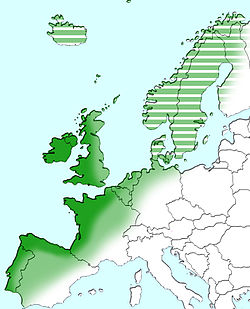
A number of authors have postulated that there still is a cultural continuum in Atlantic Europe, forming a cultural unit which has its roots in prehistoric times but remained until today mostly thanks to sea trade. Geographers also mention the influence of the natural environment in the construction of a similar cultural landscape along the western European coasts.
Some of the first geographers to consider this idea of Atlantic Europe were Otero Pedrayo and Orlando Ribeiro. Pedrayo stated in his studies about Galicia that this territory was marked by a strong "Atlantic character", not Mediterranean, despite being part of a state often perceived as Mediterranean (Spain). On the other hand, while researching about his native Portugal, Ribeiro deepened the concepts of Atlantic Europe and Mediterranean Europe, linking southern Portugal more towards the Mediterranean culture and central and northern Portugal (together with Galicia and Asturias) to a pan-Atlantic European culture.
This idea would be further developed from the 1950s onwards by authors such as P. Flatrès, Emyr Estyn Evans, A. Bouhier, Meynier, J. García Fernández, Patrick O'Flanagan, Richard Bradley, Barry Cunliffe, Carlos Ferrás Sexto and Xoán Paredes, among others.
O'Flanagan, based on the theories of Pedrayo and Ribeiro, states that Atlantic Europe is a cultural reality that stretches along the coastal fringe of Europe, from Norway to South-Central Portugal (roughly down to the Santarém area), and including Britain and Ireland. With this in mind, Paredes affirms that there exists a cultural landscape common to Atlantic (namely Celtic) Europe, mainly based on the settlement pattern, use and shared perception of the lived space, thus evidencing in itself a social and cultural internal cohesion and continuity.[10][11]
Bob Quinn in his documentary series Atlantean speculates that western European Celtic culture is actually an earlier, pre-Celtic, Atlantic culture that included Atlantic Europe and people of the Maghreb such as Berbers and that it continues today.
Atlantic Europe in politics
[edit]There is a multi-national association of regions, which acts as a co-ordinator of Atlantic European regions and its interests. This is the Atlantic Arc Commission.[12] Operative since 1989, it includes 26 regions from four member States - Great Britain, France, Spain and Portugal. The Atlantic Arc Commission is one of the seven Geographical Commissions in the Conference of Peripheral Maritime Regions of Europe.[13]
Genetics
[edit]The genetic link between the various Atlantic population is still under discussion. On the one hand, some studies show that modern and Iron Age British and Irish samples cluster genetically very closely with other North European populations, and not to southern Atlantic Europeans in Spain and France.[14][15] However, as the authors acknowledge, the sample used is unlikely to include many members of smaller genetically isolated populations that exist within countries. On the other hand, an article published in the American Journal of Genetics indicates – after including samples from different regions within European countries – a shared ancestry throughout the Atlantic zone, from northwest Iberia (Galicia) to western Scandinavia, that dates back to end of the last Ice Age.[16]
See also
[edit]- Atlantic Biogeographic Region
- Atlantic Modal Haplotype
- Celts and Norsemen
- Haplogroup R1b (Y-DNA)
- Oceanic climate
- Paleolithic continuity theory
- Western Europe
Notes
[edit]- ^ Indicative map of the European biogeographical regions 2005. Archived July 12, 2007, at the Wayback Machine
- ^ Map of the biogeographical regions of Europe
- ^ Map of the floristic regions of Europe[circular reference]
- ^ Cunliffe, B. and Koch, J.T., Celtic from the West: Alternative Perspectives from Archaeology, Genetics, Language and Literature. Oxbow books, 2012.
- ^ Bradley, R. (1997): Rock Art and the Prehistory of Atlantic Europe. Routledge
- ^ Brian Donnelly (2004): "We are not Celts at all but Galicians; DNA research links the Scots, Irish and Welsh to north-western Spain", The Herald (Glasgow - UK), p. 15.
- ^ Salas, A; Comas, D; Lareu, MV; Bertranpetit, J; Carracedo, A (1998). "mtDNA analysis of the Galician population: a genetic edge of European variation". Eur J Hum Genet. 6 (4): 365–75. doi:10.1038/sj.ejhg.5200202. PMID 9781045.
- ^ "Modern Celtic realm - National Geographic". Archived from the original on 2007-09-27. Retrieved 2007-08-13.
- ^ "Atlantic Arc Commission". Archived from the original on 2006-11-26. Retrieved 2006-12-18.
- ^ Paredes, X.M. Bases do Atlantismo Europeo Galego. Unha visión desde a Xeografía Cultural e Histórica. Tese de Licenciatura. Dept. de Xeografía, Universidade de Santiago de Compostela, 1999
- ^ Paredes, X.M.,"A utilidade do celtismo. Celticidade galaica no S.XXI", in proceedings of Jornadas das Letras Galego-Portuguesas 2012-2014, DTS and SAGA. p. 175-190, 2015.
- ^ "Atlantic Arc Commission". Archived from the original on 2006-11-26. Retrieved 2006-12-18.
- ^ Conference of Peripheral Maritime Regions
- ^ Novembre J, Johnson T, Bryc K, et al. (November 2008), "Genes mirror geography within Europe", Nature, 456 (7218): 98–101, Bibcode:2008Natur.456...98N, doi:10.1038/nature07331, PMC 2735096, PMID 18758442
- ^ Lao O, Lu TT, Nothnagel M, et al. (August 2008), "Correlation between genetic and geographic structure in Europe", Curr. Biol., 18 (16): 1241–8, doi:10.1016/j.cub.2008.07.049, PMID 18691889
- ^ McEvoy, Brian (2004). "The Longue Dure´e of Genetic Ancestry: Multiple Genetic Marker Systems and Celtic Origins on the Atlantic Facade of Europe". American Journal of Human Genetics. 75 (4): 693–702. doi:10.1086/424697. PMC 1182057. PMID 15309688. Retrieved 22 November 2022.
Sources
[edit]- Sykes, Bryan (2006). Blood of the Isles: exploring the genetic roots of our tribal history. London: Bantam. ISBN 978-0-593-05652-3.
References
[edit]- Orlando Ribeiro, Portugal o Mediterrâneo e o Atlântico, Lisboa, 1945.
- Emyr Estyn Evans, The Atlantic Ends of Europe, Advancety Offsiders, London, 1958.
- H.N. Savory, "Serpentiforms in Megalithic art: a link between Wales and the Iberian NW", in Cadernos de Estudos Galegos no. 84, p. 80-89, Santiago de Compostela, 1973.
- Patrick O'Flanagan, "La Europa Atlántica: Pasado y presente. Una revisión del concepto y de la realidad'", in proceedings of Congreso Internacional: A periferia Atlántica de Europa: o desenvolvemento e os problemas socioculturais, Universidade de Santiago Compostela, 1992.
- Patrick O'Flanagan, "Galicia en el marco geográfico e histórico de la Europa Atlántica", in Xeográfica no. 1, p. 115-133, 2001.
- Barry Cunliffe, Facing the Ocean: The Atlantic and Its Peoples, 8000 BC to AD 1500, OUP, 2001.
- Francesco Benozzo and Mario Alinei, "A área galega na prehistoria lingüística e cultural de Europa", in A Trabe de Ouro, no. 71, p. 13-39, Santiago de Compostela, 2007.
- Barry Cunliffe. and John T. Koch, Celtic from the West: Alternative Perspectives from Archaeology, Genetics, Language and Literature, Oxbow books, 2012.
- Xoán M. Paredes, "A utilidade do celtismo. Celticidade galaica no S.XXI", in proceedings of Jornadas das Letras Galego-Portuguesas, 2012-2014, DTS and SAGA, p. 175-190, 2015.
External links
[edit]- Haplogroup R1b distribution map
- Macdonald's Haplogroup map
- Rock Art in Atlantic Europe
- From the Neolithic to the Atlantic Bronze Age
- Atlantic Arc Commission - The European organisation for governmental and economical cooperation of the regions of Atlantic Europe
- Conference of Cities of the Atlantic Arc
48°00′00″N 2°00′00″W / 48.0000°N 2.0000°W
Kommunal ödənişləri qeydiyyatsız və sürətli həyata keçirin
Kommunal.az onlayn ödənişi asanlaşdırır. Onlayn Ödə, Ödəniş tarixçənizi yadda saxlayın, Hesablarınızı avtomatik ödəyin, Kartdan karta pul köçürün
Bakıda kommunal xidmətləri onlayn ödəmək 💳 ödəniş işıq pulu ödənişi ⚡️ mənzil və kommunal xidmətlər 💰 kirayə 🔒 təhlükəsiz ✅ Azərbaycanda istənilən bank kartından 📞 * 1919 | EPUL
“ASAN Kommunal” mərkəzləri bazar ertəsi - cümə günləri saat 09:00-dan-18:00-dək, şənbə günü isə saat 10:00-17:00-dək nahar fasiləsi olmadan fəaliyyət göstərir. “ASAN Kommunal” mərkəzlərində sənədlərin qəbulu həftənin beş günü saat 09:00-dan 17:30-dək, şənbə günü isə saat 10:00-dan 16:30-dək fasiləsiz həyata keçirilir.
Azərbaycan Respublikası Prezidentinin 06 avqust 2008-ci il tarixli 2983 saylı sərəncamını həyata keçirmək məqsədi ilə Bakı şəhər İcra Hakimiyyəti Başçısı 02 fevral 2009-cu il tarixdə 45 saylı sərəncamla, Bakı şəhərinin inzibati ərazisində əmələ gəlmə mənbəyindən asılı olmayaraq, bütün bərk məişət tullantılarının daşınması və zərərsizləşdirilməsini Bakı şəhər İcra Hakimiyyəti Aparatı Mənzil Kommunal Təsərrüfatı Departamentinin İxtisaslaşdırılmış Sanitariya – Təmizlik və Kommunal Xidmətlər İdarəsinə həvalə etmişdir.
Hesab.az offers online payments for Mobile, Utilities, TV, Internet, Phone and many other services
Bank Ödənişləri - Online Kommunal Ödənişlər. İndi siz mobil, internet, sığorta, bank və kredit ödənişlərinizi asanlıqla online odeme formada edə bilərsiniz. Onlayn Odeme Sizə daha yaxın
Onlayn xidmətlər - Kredit, kommunal ödənişlər, eləcə də arayış və çıxarışların alınması. Banka gəlmədən Kapital Bankın online odeme xidmətindən banka gəlmədən yararlanın
Mobile operators · Bank Services · Insurance · Phone · Kommunal Services · Cable TV · Internet · Other · Entertainment.
Elektron pul kisəsinə saytdan və ya mobil proqram vasitəsilə daxil olun. "Kommunal ödənişlər" bölməsini seçin. Öz ödəniş kodunuzu və məbləği daxil edin.
Hökumət ödənişləri Bank xidmәtlәri Mobil operatorlar Telefon Kommunal xidmәtlәr İnternet TV Sığorta Təhsil Taksi və Çatdırılma Otellər və Turizm Әylәncә
Hökumət Ödəniş Portalı (HÖP) – ölkə iqtisadiyyatında nağdsız hesablaşmaların genişləndirilməsi və bütün regionlarda maliyyə xidmətlərinə çıxış imkanlarının artırılması məqsədilə Azərbaycan Respublikası Mərkəzi Bankı tərəfindən yaradılmışdır. Portal vasitəsilə mərkəzləşdirilmiş qaydada vergi, rüsum, icarə haqqı və digər büdcə ödənişlərinin, həmçinin kommunal, rabitə və başqa kütləvi xidmətlər üzrə ödənişlərin internet üzərindən ödəniş kartlarından, bank hesablarından istifadə edilməklə, həmçinin bankların və milli poçt operatorunun maliyyə xidməti nöqtələrində nağd qaydada toplanılması təmin edilmişdir.
Çoxfunksiyalı “ASAN ödəniş” sistemi cərimə, kommunal xidmət, kabel televiziyası, mobil operator, internet və digər ödənişləri qısa zamanda, təhlükəsiz və rahat şəkildə həyata keçirmək imkanı yaradır. Respublika daxilində geniş ərazini əhatə edən “ASAN Ödəniş” terminalları, həmçinin www.asanpay.az portalı və “ASAN Pay” mobil əlavəsi vasitəsilə istənilən xidmət üzrə heç bir məhdudiyyəti olmadan 24/7 ödəniş etmək mümkündür.
Bütün xidmətlər bir Ödəmə Nöqtəsində! Qeydiyyatdan keçərək istənilən xidmətlər üzrə ödəniş edin və bonus qazanın.
Portmanat.az - elektron pulqabı, onlayn ödəmə,kommunal ödənişlər, mobil ödəmə, hesab ödənişləri, tv ödənişləri, internet ödəmə
Son illərdə həyatımıza daxil olan elektron xidmətlərdən biri də elektron ödəniş sistemləridir. Bu ödəniş sistemləri malların, iş və xidmətlərin dəyərinin ödənilməsi, öz hesabından digər şəxsin hesabına pul vəsaitinin köçürülməsi üçün istifadə edilən ödəniş alətidir.
Bütün kommunal, mobil, elektron imza, dövlət, internet, sığorta, bank, Naxçıvan və digər ödənişlərini Smartpay üzərindən et


