


Wikipediadan təsadüfi məlumatlar :
Hawaiki (also rendered as ʻAvaiki in the Cook Islands, Hawaiki in Māori, Savaiʻi in Samoan, Havaiʻi in Tahitian, Hawaiʻi in Hawaiian) is, in Polynesian folklore, the original home of the Polynesians, before dispersal across Polynesia.[1] It also features as the underworld in many Māori stories.
Anne Salmond states Havaiʻi is the old name for Raiatea, the homeland of the Māori. When British explorer James Cook first sighted New Zealand in 1769, he had on board Tupaia, a Raiatean navigator and priest. Cook's arrival seemed to be a confirmation of a prophecy by Toiroa, a priest from Mahia. At Tolaga Bay, Tupaia conversed with the tohunga associated with the school of learning located there, called Te Rawheoro. The priest asked about the Māori homelands, 'Rangiatea' (Ra'iatea), 'Hawaiki' (Havai'i, the ancient name for Ra'iatea), and 'Tawhiti' (Tahiti).[2]
Etymology
[edit]Linguists have reconstructed the term to Proto-Nuclear Polynesian *sawaiki.[3]
The Māori word Hawaiki figures in traditions about the arrival of the Māori in Aotearoa, present day New Zealand. The same concept appears in other Polynesian cultures, the name appearing variously as Havaiki, Havaiʻi, or ʻAvaiki in other Polynesian languages. Hawaiki or the misspelling "Hawaiiki" appear to have become the most common variants used in English.[citation needed] Although the Samoans have preserved no traditions of having originated elsewhere, the name of the largest Samoan island Savaiʻi preserves a cognate with the word Hawaiki, as does the name of the Polynesian islands of Hawaiʻi (the ʻokina denoting a glottal stop that replaces the "k" in some Polynesian languages).
On several island groups, including New Zealand and the Marquesas, the term has been recorded as associated with the mythical underworld and death.[3] William Wyatt Gill wrote at length in the nineteenth century recounting the legends about ʻAvaiki as the underworld or Hades of Mangaia in the Cook Islands.[4] Gill (1876:155) records a proverb: Ua po Avaiki, ua ao nunga nei – 'Tis night now in spirit-land, for 'tis light in this upper world." Tregear (1891:392) also records the term Avaiki as meaning "underworld" at Mangaia, probably sourced from Gill.[5] The proposed origin of Hawaiki being both the ancestral homeland and the underworld is that both are the dwelling places of ancestors and the spirits.
Other possible cognates of the word Hawaiki include saualiʻi ("spirits" in Samoan) and houʻeiki ("chiefs" in Tongan). This has led some scholars to hypothesize that the word Hawaiki, and, by extension, Savaiʻi and Hawaiʻi, may not, in fact, have originally referred to a geographical place, but rather to chiefly ancestors and the chief-based social structure that pre-colonial Polynesia typically exhibited.[6]
On Easter Island, the name of the home country in oral tradition appears as Hiva. According to Thor Heyerdahl, Hiva was said to lie east of the island. Sebastian Englert records:
- He-kî Hau Maka: "He kaiga iroto i te raá, iruga! Ka-oho korua, ka-û'i i te kaiga mo noho o te Ariki O'Hotu Matu'a!
- Translation: "The island towards the sun, above! Go, see the island where King Hotu Matuʻa will go and live!"
Englert puts forward the claim that Hiva lies to the West of the island.[7] The name Hiva is found in the Marquesas Islands, in the names of several islands: Nuku Hiva, Hiva Oa and Fatu Hiva (although in Fatu Hiva the hiva element may be a different word, ʻiva). It is also notable[according to whom?] that in the Hawaiian Islands, the ancestral homeland is called Kahiki, a cognate of Tahiti, where at least part of the Hawaiian population came from.
Legends
[edit]According to various oral traditions, the Polynesians migrated from Hawaiki to the islands of the Pacific Ocean in open canoes, little different from the traditional craft found in Polynesia today.[8] The Māori people of New Zealand trace their ancestry to groups of people who reportedly travelled from Hawaiki in about 40 named waka (compare the discredited Great Fleet theory of the Polynesian settlement of New Zealand).[9]
Polynesian oral traditions say that the spirits of Polynesian people return to Hawaiki after death. In the New Zealand context, such return-journeys take place via Spirits Bay, Cape Reinga and the Three Kings Islands at the extreme north of the North Island of New Zealand. This may indicate the direction in which Hawaiki may lie.[citation needed]
Modern science and practical testing of theories
[edit]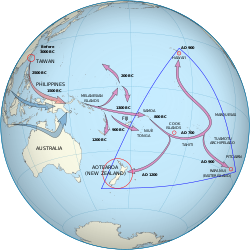
Until the early 21st century, many anthropologists had doubts that the canoe-legends described a deliberate migration. They tended to believe that the migration occurred accidentally when seafarers became lost and drifted to uninhabited shores.[citation needed]
In 1947 Thor Heyerdahl sailed the Kon-Tiki, a balsa-wood raft, from South America into the Pacific in an attempt to show that humans could have settled Polynesia from the eastern shores of the Pacific Ocean, with sailors using the prevailing winds and simple construction techniques.[10]
However, DNA, linguistic, botanical, and archaeological evidence all indicate that the Austronesian-speaking peoples (including the Polynesians) probably originated from islands in eastern Asia, possibly from present-day Taiwan.[11][12] From there they gradually migrated southwards and eastwards through the South Pacific Ocean.
The sweet potato, which is of South American origin, is widely cultivated in Polynesia. This suggests that some interaction between the Polynesians and the indigenous peoples of South America may have taken place.[13] No Polynesian crops were introduced into the Americas, and there is possible evidence of Polynesian contact only in Chile.[14] Austronesian and Polynesian navigators may have deduced the existence of uninhabited islands by observing migratory patterns of birds.[15]
In recent decades, boatbuilders (see Polynesian Voyaging Society) have constructed ocean-going craft using traditional materials and techniques. They have sailed them over presumed traditional routes using ancient navigation methods, showing the feasibility of such deliberate migration that make use of prevailing winds.[citation needed]
See also
[edit]- Hawaiʻiloa
- Hōkūleʻa
- Kupe
- Percy Smith
- Urheimat
- Polynesian navigation
Footnotes
[edit]- ^ Hiroa, Te Rangi (1964). Vikings of the Sunrise. Christchurch: Whitcombe and Tombs. p. 69. ISBN 0-313-24522-3.
- ^ Salmond, Anne (2010). Aphrodite's Island. Berkeley: University of California Press. pp. 227–228. ISBN 9780520261143.
- ^ a b Polynesian Lexicon Project Online
- ^ Gill, William Wyatt, 1876. Myths and Songs from the South Pacific. Henry S. King, London, pp 152–174.
- ^ This meaning may be archaic or forgotten in the Cook Islands today. Buse (1996:90) in his dictionary Cook Islands Maori Dictionary with English Finderlist (edited by Bruce Biggs and Rangi Moekaʻ) has this entry: Avaiki, prop. n. Hawaiki, the legendary homeland of the Polynesians. I tere tū mai rātou mei 'Avaiki. They voyaged direct from Hawaiki.
- ^ M. Taumoefolau, "From *Sau 'Ariki to Hawaiki". The Journal of the Polynesian Society, 105(4), (1996), 385–410
- ^ Englert notes that the phrase "The island towards the sun, above" seems to mean that, seen from Hiva, it lay toward the rising sun. Sourced from http://www.rongorongo.org/leyendas/008.htm
- ^ Walker, Ranginui (1980). Ka Whawhai Tonu Matou Struggle Without End. Auckland, New Zealand: Penguin Books. p. 24. ISBN 0140132406.
- ^ Walker, Ranginui (1980). Ka Whawhai Tonu Matou Struggle Without End. Auckland, New Zealand: Penguin Books. p. 24-25, 39. ISBN 0140132406.
- ^ Thor Heyerdahl (1948), Kon-Tiki ekspedisjonen (in Norwegian), Gyldendal Norsk Forlag, OL 2292673W, Wikidata Q3203414
- ^ "Mitochondrial DNA Provides a Link between Polynesians and Indigenous Taiwanese," synopsis. Public Library of Science, July 5, 2005
- ^ "The origin of the Polynesians". The Economist, July 7, 2005.
- ^ Timmer, John (21 January 2013). "Polynesians reached South America, picked up sweet potatoes, went home". Ars Technica.
- ^ Matisoo-Smith, Elizabeth; Ramirez, Jose-Miguel (January 2010). "Human Skeletal Evidence of Polynesian Presence in South America? Metric Analyses of Six Crania from Mocha Island, Chile". Journal of Pacific Archaeology. 1 (1).
- ^ Holmes, Lowell Don (1 August 1955). "Island Migrations (2): Birds and Sea Currents Aided Canoe Navigators". XXVI(1) Pacific Islands Monthly. Retrieved 1 October 2021.
References
[edit]
- Buse, J., Taringa, R., Cook Islands Maori Dictionary With English Finderlist, edited by Biggs, B. and Moeka'a R. (1996), 90. Canberra: The Australian National University.
- M. Taumoefolau, "From *Sau 'Ariki to Hawaiki". The Journal of the Polynesian Society, 105(4), (1996), 385–410.
- E. R. Tregear, Maori-Polynesian Comparative Dictionary (Lyon and Blair: Lambton Quay), 1891.
External links
[edit]- Hawaiki in Te Ara – the Encyclopedia of New Zealand
Kommunal ödənişləri qeydiyyatsız və sürətli həyata keçirin
Kommunal.az onlayn ödənişi asanlaşdırır. Onlayn Ödə, Ödəniş tarixçənizi yadda saxlayın, Hesablarınızı avtomatik ödəyin, Kartdan karta pul köçürün
Bakıda kommunal xidmətləri onlayn ödəmək 💳 ödəniş işıq pulu ödənişi ⚡️ mənzil və kommunal xidmətlər 💰 kirayə 🔒 təhlükəsiz ✅ Azərbaycanda istənilən bank kartından 📞 * 1919 | EPUL
“ASAN Kommunal” mərkəzləri bazar ertəsi - cümə günləri saat 09:00-dan-18:00-dək, şənbə günü isə saat 10:00-17:00-dək nahar fasiləsi olmadan fəaliyyət göstərir. “ASAN Kommunal” mərkəzlərində sənədlərin qəbulu həftənin beş günü saat 09:00-dan 17:30-dək, şənbə günü isə saat 10:00-dan 16:30-dək fasiləsiz həyata keçirilir.
Azərbaycan Respublikası Prezidentinin 06 avqust 2008-ci il tarixli 2983 saylı sərəncamını həyata keçirmək məqsədi ilə Bakı şəhər İcra Hakimiyyəti Başçısı 02 fevral 2009-cu il tarixdə 45 saylı sərəncamla, Bakı şəhərinin inzibati ərazisində əmələ gəlmə mənbəyindən asılı olmayaraq, bütün bərk məişət tullantılarının daşınması və zərərsizləşdirilməsini Bakı şəhər İcra Hakimiyyəti Aparatı Mənzil Kommunal Təsərrüfatı Departamentinin İxtisaslaşdırılmış Sanitariya – Təmizlik və Kommunal Xidmətlər İdarəsinə həvalə etmişdir.
Hesab.az offers online payments for Mobile, Utilities, TV, Internet, Phone and many other services
Bank Ödənişləri - Online Kommunal Ödənişlər. İndi siz mobil, internet, sığorta, bank və kredit ödənişlərinizi asanlıqla online odeme formada edə bilərsiniz. Onlayn Odeme Sizə daha yaxın
Onlayn xidmətlər - Kredit, kommunal ödənişlər, eləcə də arayış və çıxarışların alınması. Banka gəlmədən Kapital Bankın online odeme xidmətindən banka gəlmədən yararlanın
Mobile operators · Bank Services · Insurance · Phone · Kommunal Services · Cable TV · Internet · Other · Entertainment.
Elektron pul kisəsinə saytdan və ya mobil proqram vasitəsilə daxil olun. "Kommunal ödənişlər" bölməsini seçin. Öz ödəniş kodunuzu və məbləği daxil edin.
Hökumət ödənişləri Bank xidmәtlәri Mobil operatorlar Telefon Kommunal xidmәtlәr İnternet TV Sığorta Təhsil Taksi və Çatdırılma Otellər və Turizm Әylәncә
Hökumət Ödəniş Portalı (HÖP) – ölkə iqtisadiyyatında nağdsız hesablaşmaların genişləndirilməsi və bütün regionlarda maliyyə xidmətlərinə çıxış imkanlarının artırılması məqsədilə Azərbaycan Respublikası Mərkəzi Bankı tərəfindən yaradılmışdır. Portal vasitəsilə mərkəzləşdirilmiş qaydada vergi, rüsum, icarə haqqı və digər büdcə ödənişlərinin, həmçinin kommunal, rabitə və başqa kütləvi xidmətlər üzrə ödənişlərin internet üzərindən ödəniş kartlarından, bank hesablarından istifadə edilməklə, həmçinin bankların və milli poçt operatorunun maliyyə xidməti nöqtələrində nağd qaydada toplanılması təmin edilmişdir.
Çoxfunksiyalı “ASAN ödəniş” sistemi cərimə, kommunal xidmət, kabel televiziyası, mobil operator, internet və digər ödənişləri qısa zamanda, təhlükəsiz və rahat şəkildə həyata keçirmək imkanı yaradır. Respublika daxilində geniş ərazini əhatə edən “ASAN Ödəniş” terminalları, həmçinin www.asanpay.az portalı və “ASAN Pay” mobil əlavəsi vasitəsilə istənilən xidmət üzrə heç bir məhdudiyyəti olmadan 24/7 ödəniş etmək mümkündür.
Bütün xidmətlər bir Ödəmə Nöqtəsində! Qeydiyyatdan keçərək istənilən xidmətlər üzrə ödəniş edin və bonus qazanın.
Portmanat.az - elektron pulqabı, onlayn ödəmə,kommunal ödənişlər, mobil ödəmə, hesab ödənişləri, tv ödənişləri, internet ödəmə
Son illərdə həyatımıza daxil olan elektron xidmətlərdən biri də elektron ödəniş sistemləridir. Bu ödəniş sistemləri malların, iş və xidmətlərin dəyərinin ödənilməsi, öz hesabından digər şəxsin hesabına pul vəsaitinin köçürülməsi üçün istifadə edilən ödəniş alətidir.
Bütün kommunal, mobil, elektron imza, dövlət, internet, sığorta, bank, Naxçıvan və digər ödənişlərini Smartpay üzərindən et


