


Wikipediadan təsadüfi məlumatlar :
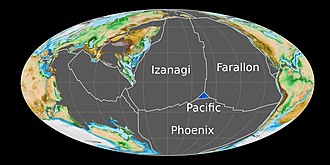
The Farallon plate was an ancient oceanic tectonic plate. It formed one of the three main plates of Panthalassa, alongside the Izanagi plate and the Phoenix plate, which were connected by a triple junction. The Farallon plate began subducting under the west coast of the North American plate—then located in modern Utah—as Pangaea broke apart and after the formation of the Pacific plate at the center of the triple junction during the Early Jurassic. It is named for the Farallon Islands, which are located just west of San Francisco, California.

Over time, the central part of the Farallon plate was subducted under the southwestern part of the North American plate. The remains of the Farallon plate are the Explorer, Gorda, and Juan de Fuca plates, which are subducting under the northern part of the North American plate; the Cocos plate subducting under Central America; and the Nazca plate subducting under the South American plate.[1]
The Farallon plate is also responsible for transporting old island arcs and various fragments of continental crust, which had rifted off other distant plates. These fragments from elsewhere are called terranes (sometimes, "exotic" terranes). During the subduction of the Farallon plate, it accreted these island arcs and terranes to the North American plate. Much of western North America is composed of these accreted terranes.
Tomographic imaging of the plate
[edit]As an ancient tectonic plate, the Farallon plate must be studied using methods that allow researchers to see deep beneath the Earth's surface. The understanding of the Farallon plate has evolved as details from seismic tomography provide improved details of the submerged remnants. Since the North American west coast has a convoluted structure, significant work has been required to resolve the complexity.[2]

Seismic tomography can be used to image the remainder of the subducted plate because it is still "cold," meaning that it has not reached thermal equilibrium with the mantle. This is important for the use of tomography because seismic waves have different velocities in materials of different temperatures, so the Farallon slab appears as a velocity anomaly on the tomography model.[3][4]
Shallow angle subduction and deformation
[edit]Multiple studies show that the subduction of the Farallon plate was characterized by a period of "flat-slab subduction," which is the subduction of a plate at a relatively shallow angle to the overriding crust (in this case, North America).[3][5][6][7] This phenomenon accounts for the far-inland orogenesis of the Rocky Mountains and other ranges in North America which are much farther from the convergent plate boundary than is typical of a subduction-generated orogeny.[5][6]

Significant deformation of the slab also occurred due to this flat subduction phenomenon, which has been imaged by seismic tomography. There is a concentration of velocity anomalies in the tomography that is thicker than the slab itself should be, indicating that folding and deformation occurred beneath the surface during subduction.[3][4][7] In other words, more of the slab should be in the lower mantle, but the deformation has caused it to remain shallower, in the upper mantle.[3]

Multiple hypotheses have been proposed to explain this shallow subduction angle and resulting deformation. Some studies suggest that the faster movement of the North American plate caused the slab to flatten, resulting in slab rollback.[3] Another cause of flat slab subduction may be slab buoyancy, a characteristic influenced by the presence of oceanic plateaus (or oceanic flood basalts).[3][8] In addition to influencing slab buoyancy, some oceanic plateaus may have also become accreted to North America.[7][8]
It has been suggested that this deformation may go so far as to include a tear in the slab, where a piece of the subducted Farallon plate has broken off, creating multiple slab remnants. This is supported by tomography studies and provides some more explanation of the formation of Laramide structures that are further inland from the edge.[4][7][9]
Interpretations of Farallon plate subduction
[edit]A 2013 study proposed two additional now-subducted plates that would account for some of the unexplained complexities of the accreted terranes, suggesting that the Farallon should be partitioned into Northern Farallon, Angayucham, Mezcalera and Southern Farallon segments based on recent tomographic models.[2][10] Under this model, the North American continent overrode a series of subduction trenches, and several microcontinents (similar to those in the modern-day Indonesian Archipelago) were added to it. These microcontinents must have had adjacent oceanic plates that are not represented in previous models of Farallon subduction, so this interpretation brings forth a different perspective on the history of collision. Based on this model, the plate moved west, causing the following geologic events to occur:[10]

- 165–155 Myr ago an exotic terrane (the Mezcalera promontory) started to be subducted and the orogenesis of the Rocky Mountains began.
- 125 Myr ago the North American plate collided with a chain of island arcs, causing the Sevier orogeny.
- 124–90 Myr ago the Omineca magmatic belts are formed in the Pacific Northwest as the Mezcalera promontory is overridden.
- 85 Myr ago Sonora volcanism in the Moctezuma volcanic field occurred.
- 85–55 Myr ago the Laramide orogeny occurred as buoyant terranes were accreted.
- 72–69 Myr ago the Carmacks volcanism occurred in present-day Canada as an island arc is completely subducted.
- 55–50 Myr ago the accretion of the Siletzia and Pacific Rim terranes occurred.[7]
- 55–50 Myr ago the conclusion of the volcanism of the Coast Mountain island arc occurred.[10]
When the final archipelago, the Siletzia archipelago, lodged as a terrane, the associated trench stepped west. When this happened, the trench that had been characterized as an oceanic-oceanic subduction environment approached the North American margin and eventually became the current Cascadia subduction zone. This created a slab window.[11]
Other models have been proposed for the Farallon's influence on the Laramide orogeny, including the dewatering of the slab which led to intense uplift and magmatism.[6]
See also
[edit]
- Izanagi plate
- Kula plate
- Kula–Farallon Ridge
- Pacific–Farallon Ridge
- San Andreas Fault
References
[edit]Notes
- ^ Lonsdale, Peter (2005-08-01). "Creation of the Cocos and Nazca plates by fission of the Farallon plate". Tectonophysics. 404 (3–4): 237–264. Bibcode:2005Tectp.404..237L. doi:10.1016/j.tecto.2005.05.011.
- ^ a b Goes 2013.
- ^ a b c d e f Schmid, Christian; Goes, Saskia; van der Lee, Suzan; Giardini, Domenico (2002-11-30). "Fate of the Cenozoic Farallon slab from a comparison of kinematic thermal modeling with tomographic images". Earth and Planetary Science Letters. 204 (1): 17–32. doi:10.1016/S0012-821X(02)00985-8. ISSN 0012-821X.
- ^ a b c van der Lee, Suzan; Nolet, Guust (March 1997). "Seismic image of the subducted trailing fragments of the Farallon plate". Nature. 386 (6622): 266–269. doi:10.1038/386266a0. ISSN 1476-4687.
- ^ a b Currie, Claire A.; Copeland, Peter (2022-01-25). "Numerical models of Farallon plate subduction: Creating and removing a flat slab". Geosphere. doi:10.1130/GES02393.1. ISSN 1553-040X.
- ^ a b c Humphreys, Eugene; Hessler, Erin; Dueker, Kenneth; Farmer, G. Lang; Erslev, Eric; Atwater, Tanya (July 2003). "How Laramide-Age Hydration of North American Lithosphere by the Farallon Slab Controlled Subsequent Activity in the Western United States". International Geology Review. 45 (7): 575–595. doi:10.2747/0020-6814.45.7.575. ISSN 0020-6814.
- ^ a b c d e Schmandt, B.; Humphreys, E. (2011-02-01). "Seismically imaged relict slab from the 55 Ma Siletzia accretion to the northwest United States". Geology. 39 (2): 175–178. doi:10.1130/G31558.1. ISSN 0091-7613.
- ^ a b Kerr, Andrew C. (2015), Harff, Jan; Meschede, Martin; Petersen, Sven; Thiede, Jörn (eds.), "Oceanic Plateaus", Encyclopedia of Marine Geosciences, Dordrecht: Springer Netherlands, pp. 1–15, doi:10.1007/978-94-007-6644-0_21-1, ISBN 978-94-007-6644-0, retrieved 2024-10-18
{{citation}}: CS1 maint: work parameter with ISBN (link) - ^ Hawley, William B.; Allen, Richard M. (2019-07-16). "The Fragmented Death of the Farallon Plate". Geophysical Research Letters. 46 (13): 7386–7394. doi:10.1029/2019GL083437. ISSN 0094-8276.
- ^ a b c Sigloch & Mihalynuk 2013.
- ^ Goes 2013; Sigloch & Mihalynuk 2013.
 | This article includes a list of general references, but it lacks sufficient corresponding inline citations. (June 2015) |
Bibliography
- Goes, Saskia (April 2013). "Western North America's jigsaw". Nature. 496 (7443): 25–27. Bibcode:2013Natur.496...35G. doi:10.1038/496035a. PMID 23552938. S2CID 205076929.
- Sigloch, Karin; Mihalynuk, Mitchell G. (4 April 2013). "Intra-oceanic subduction shaped the assembly of Cordilleran North America". Nature. 496 (7443): 50–56. Bibcode:2013Natur.496...50S. doi:10.1038/nature12019. PMID 23552944. S2CID 205233259.
- Schellart, W. P.; Stegman, D. R.; Farrington, R. J.; Freeman, J.; Moresi, L. (16 July 2010). "Cenozoic Tectonics of Western North America Controlled by Evolving Width of Farallon Slab". Science. 329 (5989): 316–319. Bibcode:2010Sci...329..316S. doi:10.1126/science.1190366. PMID 20647465. S2CID 12044269.
- Schmid, C.; Goes, S.; van der Lee, S.; Giardini, D. (2002). "Fate of the Cenozoic Farallon slab from a comparison of kinematic thermal modeling with tomographic images" (PDF). Earth Planet. Sci. Lett. 204 (1–2): 17–32. Bibcode:2002E&PSL.204...17S. doi:10.1016/S0012-821X(02)00985-8. Archived from the original (PDF) on 2015-10-15. Retrieved 2013-04-04.
- "Global plate reconstructions with velocity fields from 150 Ma to present in 10 Ma increments". Geological Survey of Norway. Archived from the original on 2011-07-23.
- "Under California: An ancient tectonic plate". Brown University.
External links
[edit]- USGS Professional Paper 1515: images of Farallon plate
- Demise of the Farallon plate Beneath North America – California Institute of Technology
- The Farallon plate Archived 2020-10-29 at the Wayback Machine – Goddard Space Flight Center
Tectonic plates | ||
|---|---|---|
| Major plates |
|  |
| Minor plates |
| |
| Microplates |
| |
| Ancient plates |
| |
| Oceanic ridges |
| |
| Ancient oceanic ridges |
| |
| ||


Kommunal ödənişləri qeydiyyatsız və sürətli həyata keçirin
Kommunal.az onlayn ödənişi asanlaşdırır. Onlayn Ödə, Ödəniş tarixçənizi yadda saxlayın, Hesablarınızı avtomatik ödəyin, Kartdan karta pul köçürün
Bakıda kommunal xidmətləri onlayn ödəmək 💳 ödəniş işıq pulu ödənişi ⚡️ mənzil və kommunal xidmətlər 💰 kirayə 🔒 təhlükəsiz ✅ Azərbaycanda istənilən bank kartından 📞 * 1919 | EPUL
“ASAN Kommunal” mərkəzləri bazar ertəsi - cümə günləri saat 09:00-dan-18:00-dək, şənbə günü isə saat 10:00-17:00-dək nahar fasiləsi olmadan fəaliyyət göstərir. “ASAN Kommunal” mərkəzlərində sənədlərin qəbulu həftənin beş günü saat 09:00-dan 17:30-dək, şənbə günü isə saat 10:00-dan 16:30-dək fasiləsiz həyata keçirilir.
Azərbaycan Respublikası Prezidentinin 06 avqust 2008-ci il tarixli 2983 saylı sərəncamını həyata keçirmək məqsədi ilə Bakı şəhər İcra Hakimiyyəti Başçısı 02 fevral 2009-cu il tarixdə 45 saylı sərəncamla, Bakı şəhərinin inzibati ərazisində əmələ gəlmə mənbəyindən asılı olmayaraq, bütün bərk məişət tullantılarının daşınması və zərərsizləşdirilməsini Bakı şəhər İcra Hakimiyyəti Aparatı Mənzil Kommunal Təsərrüfatı Departamentinin İxtisaslaşdırılmış Sanitariya – Təmizlik və Kommunal Xidmətlər İdarəsinə həvalə etmişdir.
Hesab.az offers online payments for Mobile, Utilities, TV, Internet, Phone and many other services
Bank Ödənişləri - Online Kommunal Ödənişlər. İndi siz mobil, internet, sığorta, bank və kredit ödənişlərinizi asanlıqla online odeme formada edə bilərsiniz. Onlayn Odeme Sizə daha yaxın
Onlayn xidmətlər - Kredit, kommunal ödənişlər, eləcə də arayış və çıxarışların alınması. Banka gəlmədən Kapital Bankın online odeme xidmətindən banka gəlmədən yararlanın
Mobile operators · Bank Services · Insurance · Phone · Kommunal Services · Cable TV · Internet · Other · Entertainment.
Elektron pul kisəsinə saytdan və ya mobil proqram vasitəsilə daxil olun. "Kommunal ödənişlər" bölməsini seçin. Öz ödəniş kodunuzu və məbləği daxil edin.
Hökumət ödənişləri Bank xidmәtlәri Mobil operatorlar Telefon Kommunal xidmәtlәr İnternet TV Sığorta Təhsil Taksi və Çatdırılma Otellər və Turizm Әylәncә
Hökumət Ödəniş Portalı (HÖP) – ölkə iqtisadiyyatında nağdsız hesablaşmaların genişləndirilməsi və bütün regionlarda maliyyə xidmətlərinə çıxış imkanlarının artırılması məqsədilə Azərbaycan Respublikası Mərkəzi Bankı tərəfindən yaradılmışdır. Portal vasitəsilə mərkəzləşdirilmiş qaydada vergi, rüsum, icarə haqqı və digər büdcə ödənişlərinin, həmçinin kommunal, rabitə və başqa kütləvi xidmətlər üzrə ödənişlərin internet üzərindən ödəniş kartlarından, bank hesablarından istifadə edilməklə, həmçinin bankların və milli poçt operatorunun maliyyə xidməti nöqtələrində nağd qaydada toplanılması təmin edilmişdir.
Çoxfunksiyalı “ASAN ödəniş” sistemi cərimə, kommunal xidmət, kabel televiziyası, mobil operator, internet və digər ödənişləri qısa zamanda, təhlükəsiz və rahat şəkildə həyata keçirmək imkanı yaradır. Respublika daxilində geniş ərazini əhatə edən “ASAN Ödəniş” terminalları, həmçinin www.asanpay.az portalı və “ASAN Pay” mobil əlavəsi vasitəsilə istənilən xidmət üzrə heç bir məhdudiyyəti olmadan 24/7 ödəniş etmək mümkündür.
Bütün xidmətlər bir Ödəmə Nöqtəsində! Qeydiyyatdan keçərək istənilən xidmətlər üzrə ödəniş edin və bonus qazanın.
Portmanat.az - elektron pulqabı, onlayn ödəmə,kommunal ödənişlər, mobil ödəmə, hesab ödənişləri, tv ödənişləri, internet ödəmə
Son illərdə həyatımıza daxil olan elektron xidmətlərdən biri də elektron ödəniş sistemləridir. Bu ödəniş sistemləri malların, iş və xidmətlərin dəyərinin ödənilməsi, öz hesabından digər şəxsin hesabına pul vəsaitinin köçürülməsi üçün istifadə edilən ödəniş alətidir.
Bütün kommunal, mobil, elektron imza, dövlət, internet, sığorta, bank, Naxçıvan və digər ödənişlərini Smartpay üzərindən et


