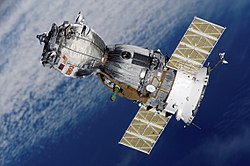
Artist's impression of the Soyuz 19 spacecraft from the Apollo–Soyuz mission
Program overview
Country
Soviet Union Russia
Organization
Roscosmos (1991–present)
Status
Ongoing
Programme history
First crewed flight
Soyuz 1
Launch site
Baikonur
Vehicle information
Uncrewed vehicle
Progress
Crewed vehicle
Soyuz
Crew capacity
1–3
Launch vehicles
Soyuz-U
Soyuz-FG
Soyuz-2
Part of a series of articles on the
Soviet space program
Soviet crewed lunar programs
Luna program
Human spaceflight programs
Vostok
Voskhod
Soyuz
Salyut
Apollo–Soyuz (joint)
Mir
Zond (lunar Soyuz 7K-L1)
N1-L3 (Moon landing)
TMK (Mars flyby)
Spiral
Almaz / TKS
Energia / Buran
Space probes
Sputnik program
Kosmos
Bion
GLONASS
Molniya
Meteor
Zenit
Luna program
Zond program
Lunokhod program
Mars program
Phobos program
Marsnik program
Astron (spacecraft)
Orion 1 and Orion 2 Space Observatories
RELIKT-1
Venera
Vega program
Expendable launch vehicles
Kosmos-3M
Molniya-M
Proton
K
Soyuz
U
Zenit
2
Energia
Kosmos
1
2I
3
3M
N1
R-7
Luna
Molniya
Polyot
Soyuz
L
M
U2
Soyuz/Vostok
Sputnik
Voskhod
Vostok
L
K
2
2M
Tsyklon
2
3
Notable figures
Konstantin Tsiolkovsky
Friedrich Zander
Mstislav Keldysh
Sergei Korolev
Laika
Yuri Gagarin
Alexander Kemurdzhian
Valentina Tereshkova
Alexei Leonov
Konstantin Feoktistov
Mikhail Tikhonravov
Mikhail Yangel
Valentin Glushko
Vladimir Chelomey
Kerim Kerimov
Vasily Mishin
Boris Chertok
Cosmonauts
List of Soviet and Russian cosmonauts
v
t
e
The Soyuz programme (/ˈsɔɪjuːz/SOY-yooz, /ˈsɔː-/SAW-; Russian: Союз[sɐˈjus], meaning "Union") is a human spaceflight programme initiated by the Soviet Union in the early 1960s. The Soyuz spacecraft was originally part of a Moon landing project intended to put a Soviet cosmonaut on the Moon.[1] It was the third Soviet human spaceflight programme after the Vostok (1961–1963) and Voskhod (1964–1965) programmes.[2]
The programme consists of the Soyuz capsule and the Soyuz rocket and is now the responsibility of Roscosmos.[3][4] After the retirement of the Space Shuttle in 2011, the Soyuz was the only way for humans to get to the International Space Station (ISS) until 30 May 2020 when Crew Dragon flew to the ISS for the first time with astronauts.[4][5]
Soyuz rocket
[edit]
Soyuz TMA-13 lifting off from Gagarin's Start at Baikonur Cosmodrome in 2008Soyuz rocket on launch pad
This section needs expansion. You can help by adding missing information. (November 2024)
The launch vehicles used in the Soyuz expendable launch system are manufactured at the Progress State Research and Production Rocket Space Center (TsSKB-Progress) in Samara, Russia. As well as being used in the Soyuz programme as the launcher for the crewed Soyuz spacecraft, Soyuz launch vehicles are now also used to launch robotic Progress supply spacecraft to the International Space Station and commercial launches marketed and operated by TsSKB-Progress and the Starsem company. Currently Soyuz vehicles are launched from the Baikonur Cosmodrome in Kazakhstan and the Plesetsk Cosmodrome in northwest Russia and, since 2011, Soyuz launch vehicles are also being launched from the Guiana Space Centre in French Guiana.[6] The Spaceport's new Soyuz launch site has been handling Soyuz launches since 21 October 2011, the date of the first launch.[7] As of December 2019, 19 Guiana Soyuz launches had been made from French Guiana Space Centre, all successful.[8][9][10]
The Soyuz rocket family is one of the most dependable and widely utilized launch vehicles in the history of space travel. It has been in operation for nearly six decades, having been developed by the Soviet Union and presently run by Russia. The Soyuz rockets have played an important role in both crewed and uncrewed space missions, launching people to the International Space Station (ISS) and delivering satellites and scientific payloads.[11]
Soyuz spacecraft
[edit]
Main article: Soyuz (spacecraft)
The basic Soyuz spacecraft design was the basis for many projects, many of which were never developed. Its earliest form was intended to travel to the Moon without employing a huge booster like the Saturn V or the Soviet N-1 by repeatedly docking with upper stages that had been put in orbit using the same rocket as the Soyuz. This and the initial civilian designs were done under the Soviet Chief Designer Sergei Korolev, who did not live to see the craft take flight. Several military derivatives took precedence in the Soviet design process, though they never came to pass.
A Soyuz spacecraft consists of three parts (from front to back):
a spheroid orbital module
a small aerodynamic reentry module
a cylindrical service module with solar panels attached
There have been many variants of the Soyuz spacecraft, including:
Sever early crewed spacecraft proposal to replace Vostok (1959)
L1-1960 crewed circumlunar spacecraft proposal (1960); evolved into the Soyuz-A design
L4-1960 crewed lunar orbiter proposal (1960)
L1-1962 crewed lunar flyby spacecraft proposal (1962); early design led to Soyuz
Soyuz 7K-T-AF (1973); 7K-T modified for space station flight with Orion 2 space telescope
Soyuz 7K-T/A9 (1974–1978); 7K-T modified for flights to military Almaz space stations
Soyuz 7K-TM (1974–1976)
7K-MF6 (1976); 7K-TM modified for space station flight with MKF-6 camera
Soyuz-T (1976–1986)
Zarya planned 'Super Soyuz' replacement for Soyuz and Progress (1985)
Alpha Lifeboat rescue spacecraft based on Zarya (1995); cancelled in favor of a modified Soyuz TM
Big Soyuz enlarged version of Soyuz reentry vehicle (2008)
Soyuz-TM (1986–2003)
Soyuz TMA (2003–2012)
Soyuz-ACTS (2006)
Soyuz TMA-M (2010–2016)
Soyuz MS (since 2016)
Military Soyuz (P, PPK, R, 7K-VI Zvezda, and OIS)
Soyuz P crewed satellite interceptor proposal (1962); cancelled in 1964 in favor of the Istrebitel Sputnikov program
Soyuz R command-reconnaissance spacecraft proposal (1962); cancelled in 1966 and replaced by Almaz
The Soyuz MS spacecraft and its Soyuz FG rocketSoyuz 7K-TK transport spacecraft proposal for delivering cosmonauts to Soyuz R military stations (1966); cancelled in 1970 in favor of the TKS spacecraft
Soyuz PPK revised version of Soyuz P (1964)
Soyuz 7K-VI Zvezda space station proposal (1964)
Soyuz-VI crewed combat spacecraft proposal; cancelled in 1965
Soyuz OIS (1967)
Soyuz OB-VI space station proposal (1967)
Soyuz 7K-S military transport proposal (1974)
Soyuz 7K-ST concept for Soyuz T and TM (1974)
Derivatives
[edit]
The Zond spacecraft was designed to take a crew around the Moon, but never achieved the required degree of safety or political need. Zond 5 did circle the Moon in September 1968, with two tortoises and other life forms, and returned safely to Earth although in an atmospheric entry which probably would have killed human travelers.
The Progress series of robotic cargo ships for the Salyut, Mir, and ISS use the engine section, orbital module, automatic navigation, docking mechanism, and overall layout of the Soyuz spacecraft, but are incapable of reentry.
While not a direct derivative, the Chinese Shenzhou spacecraft follows the basic template originally pioneered by Soyuz.[12][13]
Soyuz crewed flights
[edit]
Further information: List of Soviet human spaceflight missions and List of Russian human spaceflight missions
Soviet human spaceflight missions started in 1961 and ended in 1991 with the dissolution of the Soviet Union.
The Russian human spaceflight missions program started in 1991 and continues to this day. Soyuz crewed missions were the only spacecraft visiting the International Space Station, starting from when the Space Shuttle program ended in 2011, until the launch of Crew Dragon Demo-2 on 30 May 2020.[14][15] The International Space Station always has at least one Soyuz spacecraft docked at all times for use as an escape craft.[16][17]
Soyuz uncrewed flights
[edit]
Kosmos 133 - launch failure
Kosmos 140 - reentry damage
Kosmos 186
Kosmos 188
Kosmos 212
Kosmos 213
Kosmos 238
Soyuz 2 - failed to dock
Kosmos 379
Kosmos 396
Kosmos 434
Kosmos 496
Kosmos 573
Kosmos 613
Kosmos 638
Kosmos 656
Kosmos 670
Kosmos 672
Kosmos 772 - partial fail
Soyuz 20
Kosmos 869
Kosmos 1001
Kosmos 1074
Soyuz 34
Soyuz T-1
Soyuz TM-1
Soyuz MS-14
Soyuz MS-23
Gallery
[edit]
Soyuz TMA-3 launch
Soyuz 19 as seen from the Apollo spacecraft during Apollo–Soyuz Test Project, July 1975
Soyuz TMA-14M landing
Soyuz TMA-16M approaching the ISS
See also
[edit]
Spaceflight portal
Wikimedia Commons has media related to Soyuz program.
Shenzhou, a Chinese spacecraft influenced by Soyuz
Space Shuttle
Buran (spacecraft)
List of spaceflight-related accidents and incidents
References
[edit]
^Harland, David M. "Soyuz". Encyclopedia Britannica. Archived from the original on 27 February 2022. Retrieved 20 February 2022.
^Hendrickx, Bart (2018). "Russian Life Support Systems: Vostok, Voskhod, and Soyuz". In Seedhouse, Erik; Shayler, David J. (eds.). Handbook of Life Support Systems for Spacecraft and Extraterrestrial Habitats. Springer International Publishing. pp. 1–15. doi:10.1007/978-3-319-09575-2_39-1. ISBN 978-3-319-09575-2. Archived from the original on 20 February 2022. Retrieved 20 February 2022.
^Wild, Flint (27 June 2018). "What Is the Soyuz Spacecraft?". NASA. Archived from the original on 23 January 2022. Retrieved 20 February 2022.
^ abO'Callaghan, Jonathan (9 April 2020). "The Last Soyuz - NASA Ends Reliance On Russia With Final Launch Before Crew Dragon". Forbes. Archived from the original on 20 February 2022. Retrieved 20 February 2022.
^Luscombe, Richard; Sample, Ian (30 May 2020). "SpaceX successfully launches Nasa astronauts into orbit". The Guardian. Archived from the original on 31 May 2020. Retrieved 20 February 2022.
^"Soyuz & Vega at the Spaceport". Archived from the original on 15 April 2009.
^"Galileo: Europe readies itself for October launch". Archived from the original on 23 September 2015. Retrieved 5 June 2011.
^"CNES at Europe's Spaceport". European Space Agency. ESA. Archived from the original on 7 October 2016. Retrieved 26 December 2019.
^"ESA at Europe's Spaceport". European Space Agency. ESA. Archived from the original on 7 October 2016. Retrieved 26 December 2019.
^"Arianespace at Europe's Spaceport". European Space Agency. ESA. Archived from the original on 6 January 2017. Retrieved 26 December 2019.
^NASA Technical Reports Server (NTRS) (1 January 2010). NASA Technical Reports Server (NTRS) 20100014848: Estimating the Reliability of a Soyuz Spacecraft Mission.
^Shenzhou-5 – Quick Facts Archived 1 February 2010 at the Wayback Machine. Astronautix.com. Retrieved on 23 October 2013.
^"ShenZhou Manned Spacecraft". sinodefence.com. Archived from the original on 2 December 2010. Retrieved 18 May 2021.
^"Launch and Landing". NASA. Archived from the original on 14 September 2015. Retrieved 1 July 2011.
^Oberhaus, Daniel. "SpaceX Launched Two Astronauts—Changing Spaceflight Forever". Wired. Archived from the original on 4 June 2020. Retrieved 31 May 2020.
^"LA times, U.S.-Russian Crew Blasts Off to Space, By David Holley, 26 April 2003, Times Staff Writer". Los Angeles Times. 26 April 2003. Archived from the original on 26 December 2019. Retrieved 26 December 2019.
^Beyond the Saga of Rocket Science: In Space to Stay, By Walter Sierra, page 225-226, 2019
v
t
e
Soyuz programme
List of Soyuz missions
List of Soviet human spaceflight missions
List of Russian human spaceflight missions
Main topics
Soyuz (rocket family)
Soyuz (spacecraft)
Baikonur Cosmodrome
Site 1/5
Site 31/6
Soyuz abort modes
Cosmonaut ranks and positions
Past missions (by spacecraft type)
Soyuz 7K-OK (1966–1970)
Kosmos 133†
Soyuz 7K-OK No.1† (uncrewed)
Kosmos 140
Soyuz 1†
Kosmos 186
188
212
213
238
Soyuz 2 (uncrewed)
3
4
5
6
7
8
9
Soyuz 7K-L1 (1967–1970) (Zond lunar programme)
Kosmos 146
154†
Zond 1967A†
1967B†
Zond 4
1968A†
1968B†
5
6
1969A†
Zond-M 1†
M 2†
Zond 7
8
9
10
Soyuz 7K-L1E (1969–1970)
Soyuz 7K-L1E No.1†
Kosmos 382
Soyuz 7K-LOK (1971–1972)
Soyuz 7K-LOK No.1†
No.2†
Soyuz 7K-OKS (1971)
Soyuz 10†
11†
Soyuz 7K-T (1972–1981)
Kosmos 496
573
Soyuz 12
Kosmos 613
Soyuz 13
Kosmos 656
Soyuz 14
15†
17
18a†
18
20 (uncrewed)
21
23†
24
25†
26
27
28
29
30
31
32 (uncrewed landing)
33†
34 (uncrewed launch)
35
36
37
38
39
40
Soyuz 7K-TM (1974–1976)
Kosmos 638
672
Soyuz 16
19 (Apollo–Soyuz)
22
Soyuz 7K-S (1974–1976)
Kosmos 670
772†
869†
Soyuz-T (1978–1986)
Kosmos 1001†
1074
Soyuz T-1 (uncrewed)
T-2
T-3
T-4
T-5
T-6
T-7
T-8†
T-9
T-10a†
T-10
T-11
T-12
T-13
T-14
T-15
Soyuz-TM (1986–2002)
Soyuz TM-1 (uncrewed)
TM-2
TM-3
TM-4
TM-5
TM-6
TM-7
TM-8
TM-9
TM-10
TM-11
TM-12
TM-13
TM-14
TM-15
TM-16
TM-17
TM-18
TM-19
TM-20
TM-21
TM-22
TM-23
TM-24
TM-25
TM-26
TM-27
TM-28
TM-29
TM-30
TM-31
TM-32
TM-33
TM-34
Soyuz-TMA (2002–2012)
Soyuz TMA-1
TMA-2
TMA-3
TMA-4
TMA-5
TMA-6
TMA-7
TMA-8
TMA-9
TMA-10
TMA-11
TMA-12
TMA-13
TMA-14
TMA-15
TMA-16
TMA-17
TMA-18
TMA-19
TMA-20
TMA-21
TMA-22
Soyuz-TMA-M (2010–2016)
Soyuz TMA-01M
TMA-02M
TMA-03M
TMA-04M
TMA-05M
TMA-06M
TMA-07M
TMA-08M
TMA-09M
TMA-10M
TMA-11M
TMA-12M
TMA-13M
TMA-14M
TMA-15M
TMA-16M
TMA-17M
TMA-18M
TMA-19M
TMA-20M
Soyuz MS (2016–present)
Soyuz MS-01
MS-02
MS-03
MS-04
MS-05
MS-06
MS-07
MS-08
MS-09
MS-10†
MS-11
MS-12
MS-13
MS-14 (uncrewed)
MS-15
MS-16
MS-17
MS-18
MS-19
MS-20
MS-21
MS-22 (uncrewed landing)
MS-23 (uncrewed launch)
MS-24
MS-25
MS-26
MS-27
Current missions
MS-28
Future missions
2026
MS-29
2027
MS-30
MS-31
Uncrewed missions are designated as Kosmos instead of Soyuz; exceptions are noted "(uncrewed)". The † sign designates failed missions. Italics designates cancelled missions.
v
t
e
Soyuz spacecraft variants
Early programme
Sever
Soyuz 7K
Soyuz 9K
Soyuz 11K
Soyuz-VI
Soyuz P
Soyuz PPK
Soyuz R
7K series
Soyuz 7K-OK
Soyuz 7K-L1
Soyuz 7K-LOK
Soyuz 7K-TK
Soyuz 7K-T/AF
Soyuz 7K-OKS
Soyuz 7K-T
Soyuz 7K-TM
Soyuz 7K-MF6
Later series
Soyuz T
Soyuz TM
Soyuz TMA
Soyuz TMA-M
Soyuz MS
Progress
Progress 7K-TG
Progress M
Progress M1
Progress MS
Other derivatives
Aelita
Gamma
v
t
e
Soviet and Russian government human spaceflight programs
Bakıda kommunal xidmətləri onlayn ödəmək 💳 ödəniş işıq pulu ödənişi ⚡️ mənzil və kommunal xidmətlər 💰 kirayə 🔒 təhlükəsiz ✅ Azərbaycanda istənilən bank kartından 📞 * 1919 | EPUL
“ASAN Kommunal” mərkəzləri bazar ertəsi - cümə günləri saat 09:00-dan-18:00-dək, şənbə günü isə saat 10:00-17:00-dək nahar fasiləsi olmadan fəaliyyət göstərir. “ASAN Kommunal” mərkəzlərində sənədlərin qəbulu həftənin beş günü saat 09:00-dan 17:30-dək, şənbə günü isə saat 10:00-dan 16:30-dək fasiləsiz həyata keçirilir.
Azərbaycan Respublikası Prezidentinin 06 avqust 2008-ci il tarixli 2983 saylı sərəncamını həyata keçirmək məqsədi ilə Bakı şəhər İcra Hakimiyyəti Başçısı 02 fevral 2009-cu il tarixdə 45 saylı sərəncamla, Bakı şəhərinin inzibati ərazisində əmələ gəlmə mənbəyindən asılı olmayaraq, bütün bərk məişət tullantılarının daşınması və zərərsizləşdirilməsini Bakı şəhər İcra Hakimiyyəti Aparatı Mənzil Kommunal Təsərrüfatı Departamentinin İxtisaslaşdırılmış Sanitariya – Təmizlik və Kommunal Xidmətlər İdarəsinə həvalə etmişdir.
Bank Ödənişləri - Online Kommunal Ödənişlər. İndi siz mobil, internet, sığorta, bank və kredit ödənişlərinizi asanlıqla online odeme formada edə bilərsiniz. Onlayn Odeme Sizə daha yaxın
Elektron pul kisəsinə saytdan və ya mobil proqram vasitəsilə daxil olun. "Kommunal ödənişlər" bölməsini seçin. Öz ödəniş kodunuzu və məbləği daxil edin.
Hökumət ödənişləri Bank xidmәtlәri Mobil operatorlar Telefon Kommunal xidmәtlәr İnternet TV Sığorta Təhsil Taksi və Çatdırılma Otellər və Turizm Әylәncә
Hökumət Ödəniş Portalı (HÖP) – ölkə iqtisadiyyatında nağdsız hesablaşmaların genişləndirilməsi və bütün regionlarda maliyyə xidmətlərinə çıxış imkanlarının artırılması məqsədilə Azərbaycan Respublikası Mərkəzi Bankı tərəfindən yaradılmışdır. Portal vasitəsilə mərkəzləşdirilmiş qaydada vergi, rüsum, icarə haqqı və digər büdcə ödənişlərinin, həmçinin kommunal, rabitə və başqa kütləvi xidmətlər üzrə ödənişlərin internet üzərindən ödəniş kartlarından, bank hesablarından istifadə edilməklə, həmçinin bankların və milli poçt operatorunun maliyyə xidməti nöqtələrində nağd qaydada toplanılması təmin edilmişdir.
Çoxfunksiyalı “ASAN ödəniş” sistemi cərimə, kommunal xidmət, kabel televiziyası, mobil operator, internet və digər ödənişləri qısa zamanda, təhlükəsiz və rahat şəkildə həyata keçirmək imkanı yaradır. Respublika daxilində geniş ərazini əhatə edən “ASAN Ödəniş” terminalları, həmçinin www.asanpay.az portalı və “ASAN Pay” mobil əlavəsi vasitəsilə istənilən xidmət üzrə heç bir məhdudiyyəti olmadan 24/7 ödəniş etmək mümkündür.
Son illərdə həyatımıza daxil olan elektron xidmətlərdən biri də elektron ödəniş sistemləridir. Bu ödəniş sistemləri malların, iş və xidmətlərin dəyərinin ödənilməsi, öz hesabından digər şəxsin hesabına pul vəsaitinin köçürülməsi üçün istifadə edilən ödəniş alətidir.


![[icon]](http://upload.wikimedia.org/wikipedia/commons/thumb/1/1c/Wiki_letter_w_cropped.svg/20px-Wiki_letter_w_cropped.svg.png)


 Soyuz TMA-3 launch
 Soyuz 19 as seen from the Apollo spacecraft during Apollo–Soyuz Test Project, July 1975
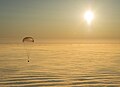 Soyuz TMA-14M landing
 Soyuz TMA-16M approaching the ISS